
Kung Fu Body™ · Stance Training
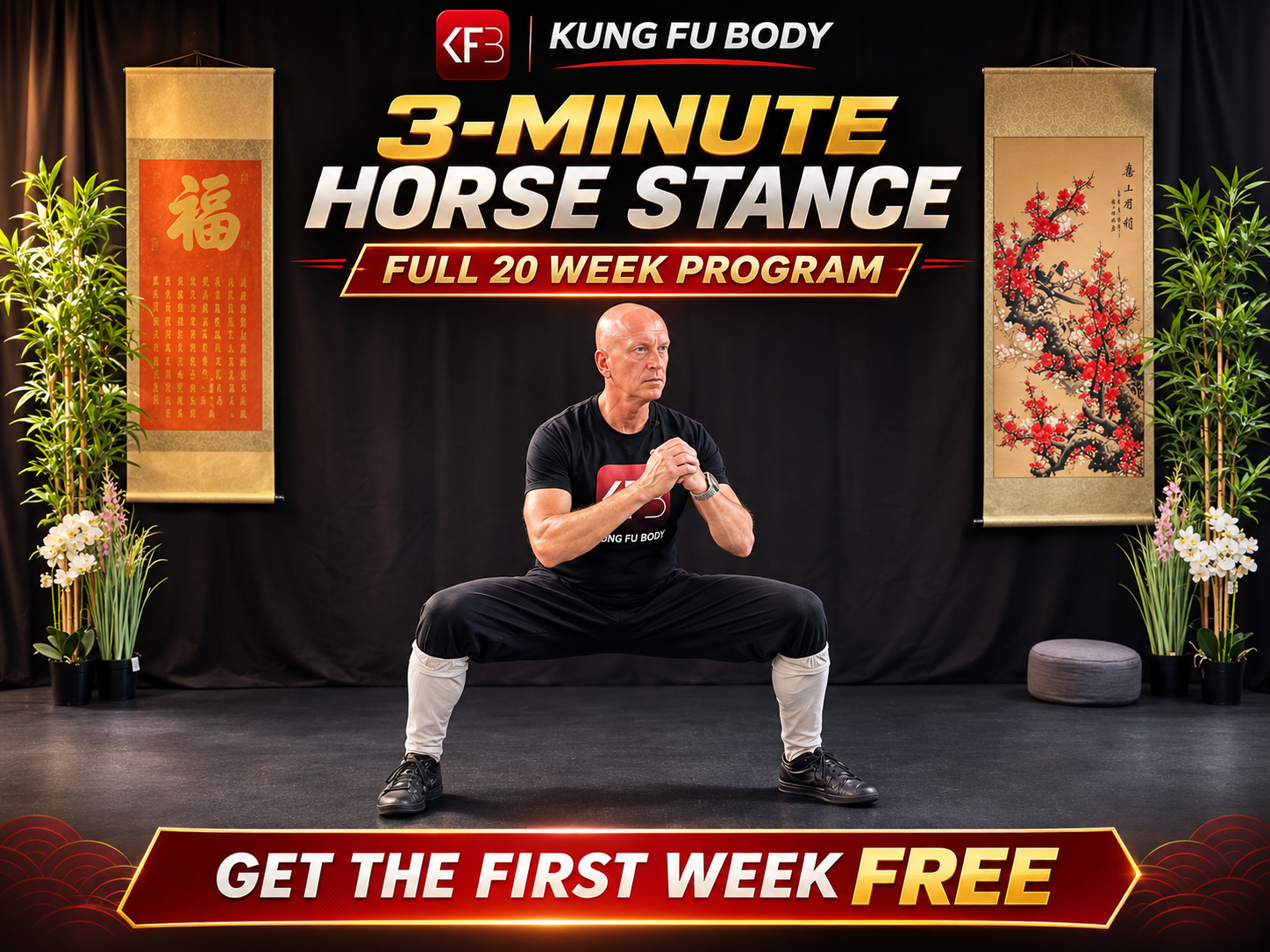
The 3-Minute Horse Stance
Stronger legs, steadier balance and a straighter back, from one kung fu stance. About twenty minutes, three times a week, in your own living room. No gym, no equipment.
Get the first week — Free
Three sessions with a built-in timer, delivered straight to your inbox.
Free. No card needed. Unsubscribe whenever you like.
Most programs ask you to do more.
This one asks you to stand still.
What it does for your body
Why kung fu has trained this stance for centuries
Ma Bu looks like nothing: feet wide, knees bent, back straight. But holding it asks a great deal of the body, and that is exactly what makes it useful after 40.
Stronger legs
Your thighs, hips and glutes carry you through the hold. These are the muscles you use to climb stairs, get up from a chair and lift something from the floor.
Steadier balance
You learn to stand rooted, with your weight spread evenly over both feet. Strong legs and a stable base are what keep you upright when you stumble.
Support for knees and hips
The hold strengthens the muscles around the knee, and the wide stance gradually opens the hips. You start high and only go deeper as your body is ready.
A straighter back
Every hold trains the same posture: spine long, chest open, shoulders down. Twenty weeks of that carries over into how you stand and sit.
Heart and circulation
Holding a squat position is a form of isometric training. Research on held squats like the wall squat shows a clear effect on resting blood pressure.
Calm under effort
When your legs start to burn, you keep breathing and stay still. Every session practises staying steady while something is hard.
What the research says
Strong legs and held squats matter for health
Balance and falls. Weakness in the legs is a recognised risk factor for falling in older adults, and research summaries conclude that exercises which strengthen the legs can reduce that risk.
Blood pressure. A review of 270 trials with almost 16,000 people found isometric training, holding a position under tension, to be the most effective form of exercise for lowering resting blood pressure, with the wall squat as the most effective variant.
Ma Bu is a free-standing version of a held squat. This program itself has not been tested in a study, it is not a medical treatment, and results differ from person to person. Never hold your breath during a hold. If you have high blood pressure or a heart condition, ask your doctor before you start.
The idea
One position. One number on a clock.
You have started things before. A gym membership, an app, a plan with a calendar. It held for a while, and then it did not. Not because you are lazy. There was simply too much to decide every time.
The horse stance removes all of that. You always know what today asks of you, and you always know whether you did it.
Week 1 to week 20
0:10to3:00
10 seconds3 minutes
Your free week
Three sessions. By day 3 you hold twice as long as on day 1.
In week 1 you stand high, with only a slight bend in the knees. The goal is to learn the position. Depth does not matter yet.
On day 3 your first hold reaches for the next step. Fall short? Then you simply do the rest of the schedule.
Week 1
Day 1 · Ease in4 × 10 sec
Day 2 · Volume4 × 10 sec
Day 3 · Max attempt20 sec
The session
The same five parts, every time
You never have to work out what comes next. The page shows each session step by step and has a timer for the holds. About twenty minutes, three times a week, with a rest day in between.
One session
Breath and activation2 min
Warm-up5 min
The Ma Bu holdsthe core
Supporting workabout 8 min
Close2 min
The progression
From ten seconds to three minutes, about ten seconds at a time
The progression is slow on purpose. You start high in the stance and go deeper as the weeks pass. Correct position always comes before a longer time.
The path
Week 110 seconds
Week 81 minute
Week 142 minutes
Week 203 minutes
Who this is for
✓ You're 40+ and starting from zero
✓ You've tried something before and stopped
✓ You want one clear task, not a long list
✓ You want to train at home, on your own
✓ You have 20 minutes, three times a week
✓ You've started things over more than once
It is not for you if you want fast results in a few days, or if you are looking for fighting, self-defence or high-intensity training.
An honest note
This is the twenty-minute version
In a kung fu school nobody trains the horse stance with a clock. You train for hours every day, the stance comes back again and again, and over time you grow into it.
Most people do not have those hours. This program is the version for people who have twenty minutes, three times a week: short holds, a small step each week, and rest days in between because that is when the strength is built.
Your thighs will burn during the holds. That is normal and it is the training working. Pain in the knee is different and means stop. If you have a knee or hip condition, check with your doctor before you start.
JAN SIFU
I've been teaching Wing Chun Kung Fu for over 20 years. Third generation Ip Man lineage — Samuel Kwok.
But Kung Fu Body™ was not built for my Kung Fu students.
It was built for people outside that world. People who know they need to move. Who have tried more than once. Who stop every time — not out of laziness, but because something was missing.
That gap — between what you know and what you do — I've watched it for twenty years. And I knew that the principles behind Kung Fu: the structure, the breathing, the fixed repetition — were exactly the tools to close it.
Not for athletes. For ordinary people.
READ MORE ABOUT JAN SIFU →What happens after the free week
Week 1 is yours to keep, with no card and no obligation.
If you want to continue, weeks 2 to 20 cost $27. One payment, no subscription. If you do not, you simply stop, and nothing else happens.
Would you rather have all 20 weeks from the start? Get the full program here.
Frequently Asked Questions
How long is a session?
About twenty minutes. Three times a week, with at least one rest day between sessions.
What do I get right now, for free?
The first week of the program: three sessions, each shown step by step, with a timer for the holds. It opens on your phone or computer.
Do I need equipment or a gym?
No. You need a bit of floor and a wall for the wall sit.
Do I need to know anything about Kung Fu or martial arts?
No. The program starts from zero. There is no fighting and no partner work.
What about my knees?
You begin high and go deeper only as the weeks pass, with the knees always in line with the feet. Burning thighs are expected. Pain in the knee joint means stop. If you have an existing knee or hip condition, ask your doctor first.
I have high blood pressure. Can I do this?
Ask your doctor first. Holding a position under tension raises your blood pressure for as long as the hold lasts, which is why the program always tells you to keep breathing and never hold your breath.
What does it cost after the free week?
Weeks 2 to 20 cost $27, paid once. There is no subscription, and you are never charged unless you choose to continue.
Start today. Free.
Three sessions, ten seconds at a time. Tell me where to send week 1 and you can do your first session today.
Send Me Week 1
We're not just selling stuff. We're building a community of people committed to health & longevity.


© 2026 Jan Sifu / iVitsi International LLC. All rights reserved.